 Image 1 of 3
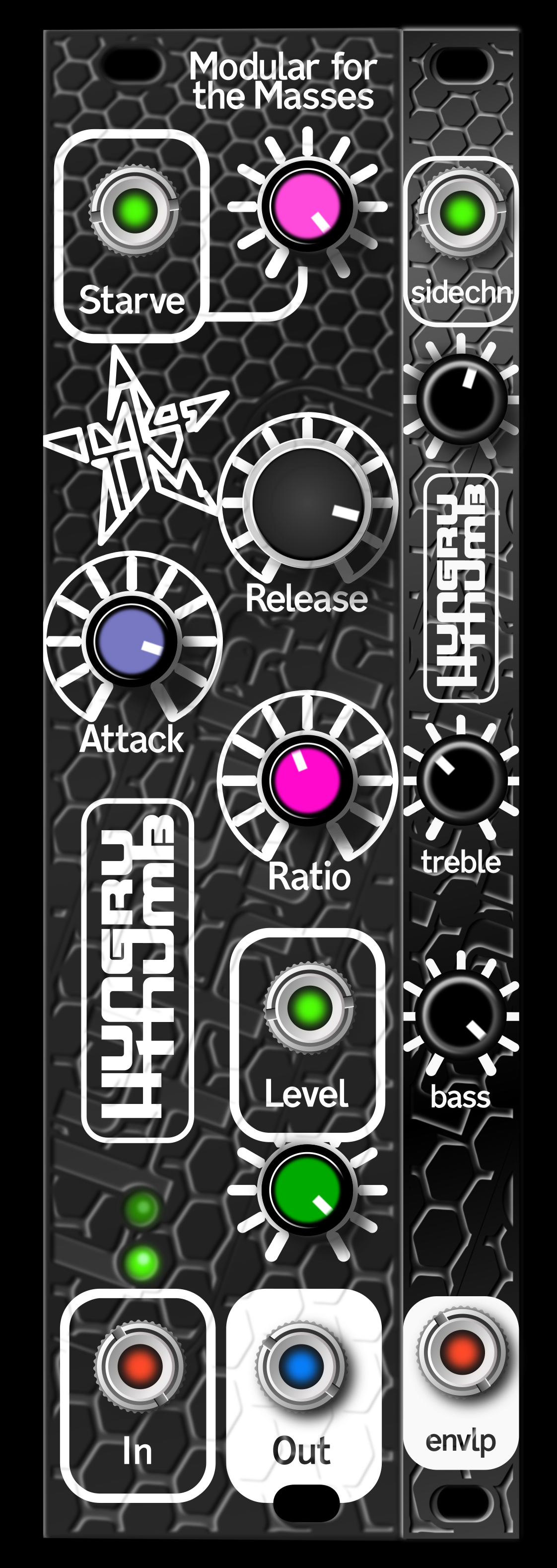 Image 2 of 3
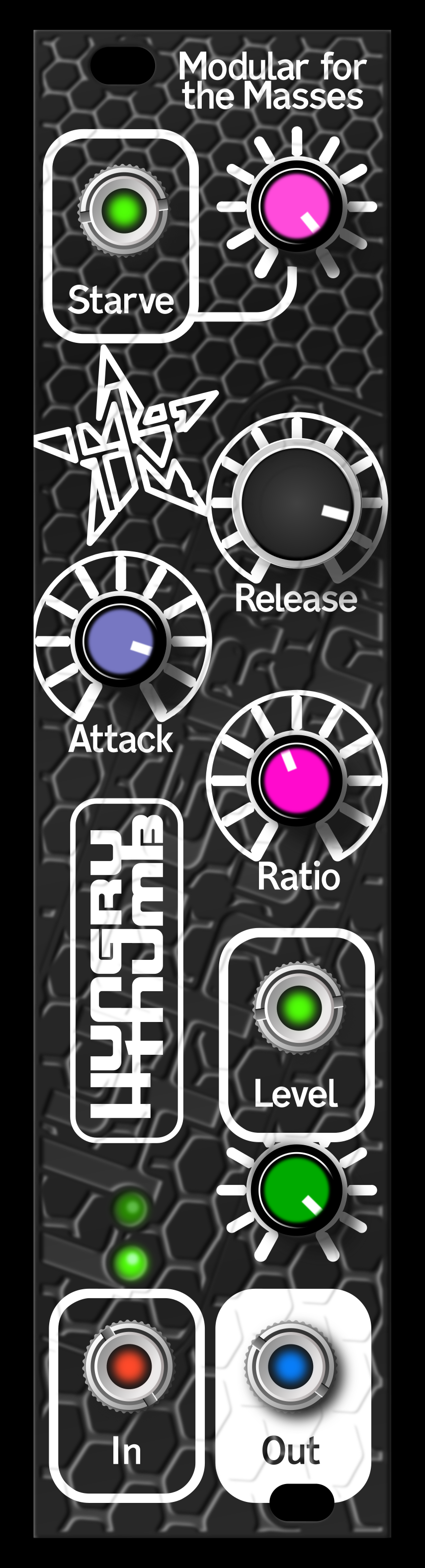 Image 3 of 3
HungryThumb is a Eurorack adaptation of a compressor named Engineer's Thumb, typically built as a guitar effect pedal. Juanito built an Engineer's Thumb early in the tin can synth journey, naively replicating the 9V core of the circuit, and then didn't really know what to do with it.
Until they put an 808 kick drum through it. As a kick drum processor, this compressor shines brightly, especially when the Starve settings reduces the core circuitry voltage to 9V and lower. You can get even the purest 808-style kick drum signal, which will be mostly a sine wave, to crunch, clip, gate, fizz and fold. Do you need hardstyle kicks in your modular? This can get you there.
The Engineer's Thumb this circuit is based on uses an LM13700 OTA chip as the adjustable gain portion. These chips are a bit noisy, so an innovation of Engineer's Thumb was to put the gain section in an op amp inverting feedback loop, meaning while the compressor is set to its highest gain, the OTA is set to its lowest gain, and will theoretically be creating less noise. The theory checks out, but I'm not sure how much we Eurorack people care about noise floor.
The HungryThumb can "starve" the compressor circuitry down to zero volts, with the knob and also with a CV. You can use this module as a very non-linear distorting VCA if you feel the need to do that. It's possible, of course, to use this compressor to process an audio signal of varying amplitude, like a field recording or a vocal track, and if you keep the parameters set to middling values, it'll be as subtle and effective as any decent compressor. But where's the fun in that? Get those parameters edgy! Gabber up those kicks!
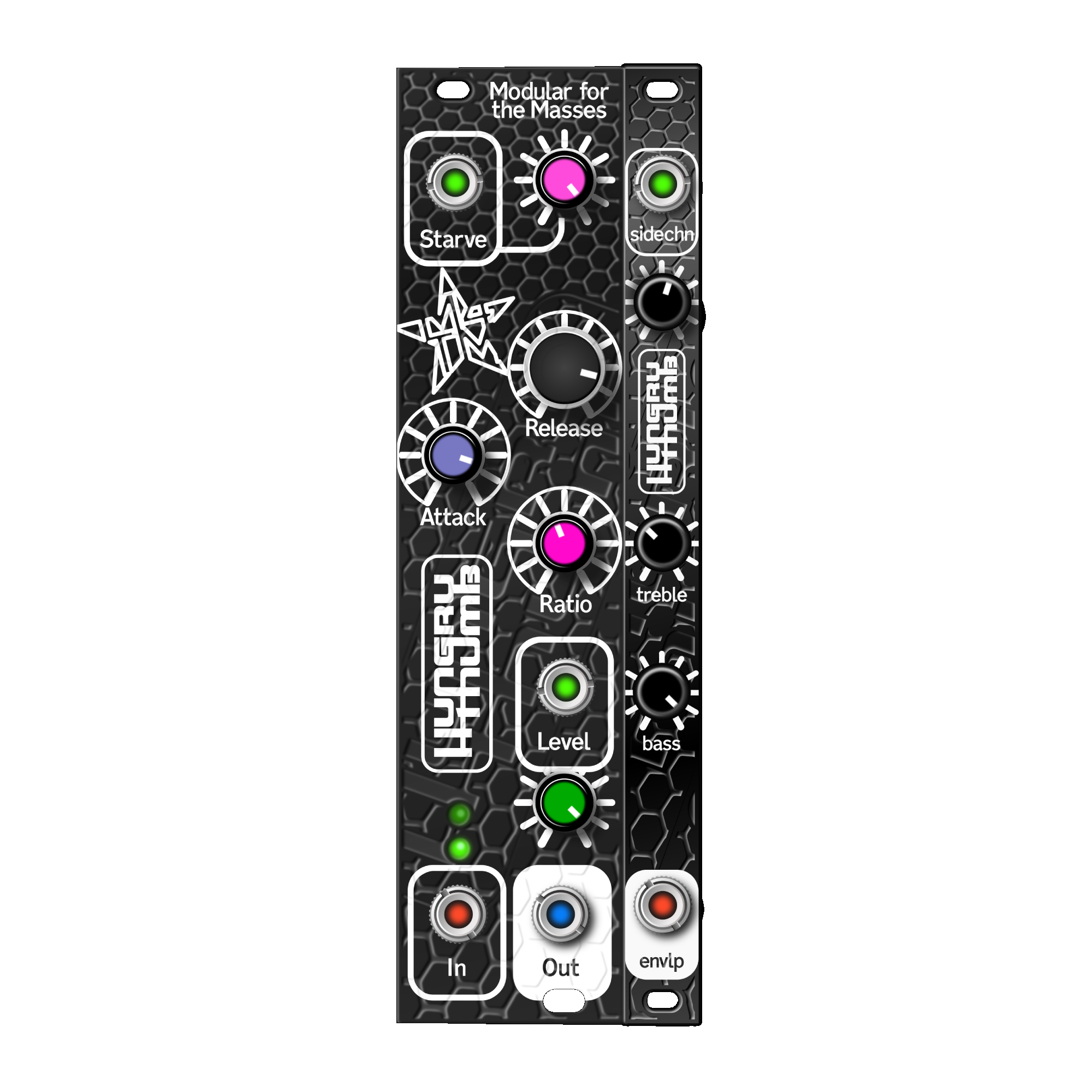
The expansion board adds 2HP of panel width. More importantly, it adds a sidechain input -- a way to control the compressor's behavior without mixing in another channel of audio.
There's also a 2-band EQ, bass and treble.
Finally on the expansion, there's an Envelope out, which will be an envelope based on the amplitude of the input signal.
Function breakdown:
Starve: this input jack and knob set the voltage of the compressor circuitry. Lower voltages let the chips work far outside of their intended parameters, which can sound great.
Release: turning this knob up increases the time the compressor takes to "settle", so if there's a spike in the incoming signal's amplitude, higher settings will make the compressor stay quiet for longer.
Attack: turning this knob up increases the compressor's sensitivity to spikes in amplitude of the incoming signal.
Ratio: turning this knob up increases a resistance parallel to the LM13700's gain stage. I'm not sure how to describe what this knob does, but it has quite an effect. With Starve set to maximum, higher Ratio knob positions soften the sound, while adding some high frequency content. At lower Starve settings, this knob adds sharp clipping sounds to the sound.
Level: this knob and jack control the module's output level. Compressors only "turn down" a signal, so some makeup gain makes sense, and here's where you can get that. There is a proper VCA behind this knob and jack, so you can voltage-control this without losing signal quality.
The pair of LEDs just up from the input jack are clipping diodes -- they will distort incoming signals higher than the diode's forward voltage. Red diodes here will clip most, blue or white or pink will clip least. Removing these LEDs altogether will keep the signal unclipped until reaching the compressor core. I usually choose green LEDs here, and they sound great.
(If you choose not to use the expander, you'll need to put a pair of jumpers on the pins marked on the PCB.
HungryThumb is a Eurorack adaptation of a compressor named Engineer's Thumb, typically built as a guitar effect pedal. Juanito built an Engineer's Thumb early in the tin can synth journey, naively replicating the 9V core of the circuit, and then didn't really know what to do with it.
Until they put an 808 kick drum through it. As a kick drum processor, this compressor shines brightly, especially when the Starve settings reduces the core circuitry voltage to 9V and lower. You can get even the purest 808-style kick drum signal, which will be mostly a sine wave, to crunch, clip, gate, fizz and fold. Do you need hardstyle kicks in your modular? This can get you there.
The Engineer's Thumb this circuit is based on uses an LM13700 OTA chip as the adjustable gain portion. These chips are a bit noisy, so an innovation of Engineer's Thumb was to put the gain section in an op amp inverting feedback loop, meaning while the compressor is set to its highest gain, the OTA is set to its lowest gain, and will theoretically be creating less noise. The theory checks out, but I'm not sure how much we Eurorack people care about noise floor.
The HungryThumb can "starve" the compressor circuitry down to zero volts, with the knob and also with a CV. You can use this module as a very non-linear distorting VCA if you feel the need to do that. It's possible, of course, to use this compressor to process an audio signal of varying amplitude, like a field recording or a vocal track, and if you keep the parameters set to middling values, it'll be as subtle and effective as any decent compressor. But where's the fun in that? Get those parameters edgy! Gabber up those kicks!
The expansion board adds 2HP of panel width. More importantly, it adds a sidechain input -- a way to control the compressor's behavior without mixing in another channel of audio.
There's also a 2-band EQ, bass and treble.
Finally on the expansion, there's an Envelope out, which will be an envelope based on the amplitude of the input signal.
Function breakdown:
Starve: this input jack and knob set the voltage of the compressor circuitry. Lower voltages let the chips work far outside of their intended parameters, which can sound great.
Release: turning this knob up increases the time the compressor takes to "settle", so if there's a spike in the incoming signal's amplitude, higher settings will make the compressor stay quiet for longer.
Attack: turning this knob up increases the compressor's sensitivity to spikes in amplitude of the incoming signal.
Ratio: turning this knob up increases a resistance parallel to the LM13700's gain stage. I'm not sure how to describe what this knob does, but it has quite an effect. With Starve set to maximum, higher Ratio knob positions soften the sound, while adding some high frequency content. At lower Starve settings, this knob adds sharp clipping sounds to the sound.
Level: this knob and jack control the module's output level. Compressors only "turn down" a signal, so some makeup gain makes sense, and here's where you can get that. There is a proper VCA behind this knob and jack, so you can voltage-control this without losing signal quality.
The pair of LEDs just up from the input jack are clipping diodes -- they will distort incoming signals higher than the diode's forward voltage. Red diodes here will clip most, blue or white or pink will clip least. Removing these LEDs altogether will keep the signal unclipped until reaching the compressor core. I usually choose green LEDs here, and they sound great.
(If you choose not to use the expander, you'll need to put a pair of jumpers on the pins marked on the PCB.